
Download Cruise Trade News’ 2026 Annual Report
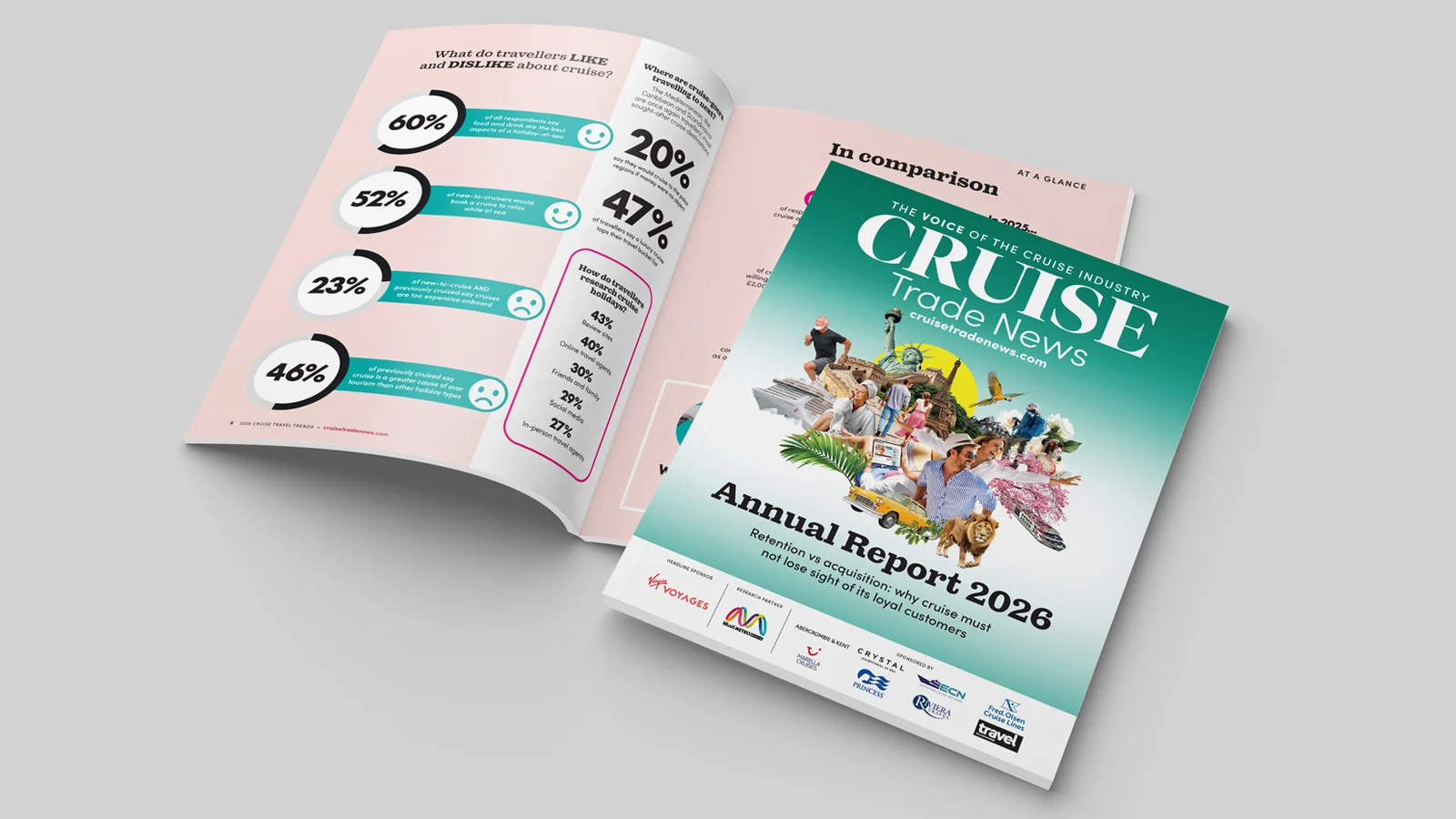
Available to download now, our second Annual Cruise Industry Report can reveal that some seasoned sailors are looking to different holiday types for their next trip abroad
The white paper surveyed almost 800 new-to-cruise and experienced cruise customers to investigate their perceptions of holidays-at-sea in 2026 and beyond. The research and analysis carried out throughout the special issue strives to help travel agents and cruise executives keep their fingers on the pulse of one of the travel industry’s fastest growing sectors.
Our exclusive research, produced in partnership with Mail Metro Media, reveals that of the respondents who are unlikely to cruise again in the next two years, a significant 42 per cent say it’s because they’ve decided to try a different type of holiday, with nearly one in 10 saying they’re no longer interested in cruise whatsoever.
Download the Cruise Trade News Annual Report 2026
Meanwhile, a quarter (26 per cent) say they no longer have the time to go on a cruise and 18 per cent say they simply can’t afford to. And when asked if they’ve booked their next cruise, a sizeable 66 per cent of repeat customers admit they have yet to do so. These stark findings pose the question: is the cruise industry on the cusp of a guest retention crisis?
Robbie O’Grady, founder of The Cruise Room, says guests are starting to “lose faith” in some of the cruise lines they’ve sailed with previously because “the experience is not the same as it used to be”. This, O’Grady argues, could be due to cutbacks in services and crew.
“The statistic is worrying and is perhaps being masked slightly by the huge surge of new-to-cruise guests ensuring that record numbers are still cruising. However, it could be argued that the numbers are not growing as much as might have been anticipated – or the industry would have liked – versus the numbers of guests actually taking a cruise holiday,” he says.
“Cruise lines could do more, like offering better onboard sales promotions, improved loyalty schemes, more genuine – rather than ever-changing – promotions and greater incentives to book early.”
UK households still face cost-of-living pressures, despite the recent softening in inflation, along with rising economic uncertainty
In last year’s Annual Report, we revealed that price was the biggest barrier to booking a holiday at sea, both for repeat and new-to-cruisers. We can reveal that this will once again be a significant issue for many in 2026.
Last year’s survey revealed that 34 per cent of respondents could no longer afford to book a cruise. According to this year’s data, that figure has risen to 35 per cent. Meanwhile, 80 per cent of respondents have yet to book their next cruise, with 48 per cent citing price as the main reason.
This year we also asked consumers how much they would be willing to pay for a cruise. We found a significant disparity between over 45s and under 45s over the price of a seven-day Mediterranean cruise.
The under-45 market would consider £5,243pp to be too expensive, while over 45s believe £2,931pp would put the trip into the unaffordable bracket. These findings show a clear disconnect between generations when it comes to price perception.
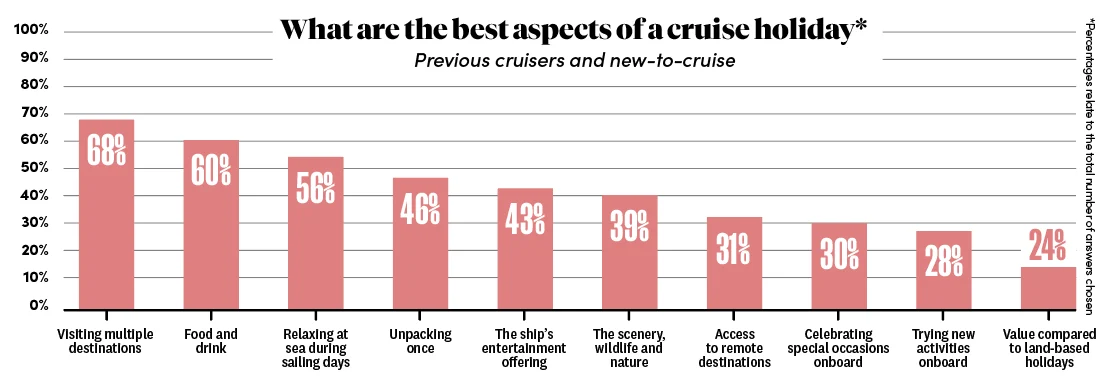
While younger travellers have a higher tolerance for premium pricing, possibly due to the rising cost of living, older consumers appear far more price-sensitive, raising questions about whether cruise is still seen as a good value holiday by the industry’s most loyal customers.
“UK households still face cost-of-living pressures, despite the recent softening in inflation, along with rising economic uncertainty. Those conditions result in weaker consumer confidence,” says Neil Bellamy, consumer insights director at GfK, the company behind the UK’s longest-running consumer confidence index.
Ultimately, our data suggests the industry’s fixation on the new-to-cruise market has led to a strategic blind spot. Growing capacity increases the need to source new customers, but retention is the cheaper, more resilient engine of long-term growth.
When almost half of potential cruisers are stalled by price confusion and a significant number of repeat guests are drifting back to land-based alternatives, our survey shows that lines and agents need to speak more plainly about value, inclusivity and ease of booking.
In 2026, success might not be measured by how many first-timers step onboard, but by how many experienced guests feel compelled to return. Ignore that balance, and the industry risks filling new ships with short-term curiosity rather than long-term loyalty.